Focus, company and kind words
Digital body doubles, and a tiny friend that cheers you on
Working beside someone, hearing a kind word, seeing a little progress: each can make work easier to start and keep going. This guide covers the broader research on company and encouragement, where the evidence stops, and how we built those ideas into a tiny companion for your Mac. For ADHD-specific study routines, see our ADHD study companion guide.
A digital body double is company you work alongside through a screen. Body-doubling research remains limited. The studies discussed here examine different settings, from physical exercise to work diaries; they do not establish that a desktop pet improves productivity or ADHD symptoms. Paw-Paw borrows the gentlest parts of this idea without claiming to be a body double: it is a free Mac desktop pet that types along with you, naps when you rest, and now and then offers a kind word when your pace dips.
What a digital body double is
Body doubling means doing a task with someone else present. They don’t help with the task; they are simply there. The ADHD coach Linda Anderson named the practice in 1996, and the Attention Deficit Disorder Association still publishes her original article. It has spread well beyond ADHD circles since.
In a 2024 survey of 220 primarily neurodivergent respondents, researchers described body doubling as using other people’s presence to start a task, stay focused on it, or finish it. Their participants used it for studying and work, but also for dishes, cleaning and exercise. The double could be in the room or remote, live or recorded, a friend or a stranger, and many people had used the trick for years before they learned it had a name.
A digital body double is that company delivered through a screen. It comes in a few strengths:
- Scheduled video sessions. Services such as Focusmate and Flow Club pair you with other people for a timed block of work, usually with a stated goal at the start and a check-in at the end.
- Study-with-me streams. Live or recorded videos of someone working quietly. A CHI 2021 study of these videos found viewers used them for ambience, a gentle, “controllable” kind of peer pressure, and emotional support.
- Ambient companions. A lighter presence that shares your screen without a person behind it. A 2026 research roadmap on body doubling sorts possible body doubles by embodiment, from ambient light and sound through 2D avatars to robots, and calls for empirical studies of them.
Paw-Paw is an ambient companion next to these: an animated pet that keeps you company, not a person and not a human body-doubling service. If you are wondering about ADHD specifically, our ADHD study companion article looks at how a desktop pet compares with human body doubling and where its limits are.
Why working in company can help
Psychologists have studied the effect of other people’s presence for more than a century, under the name social facilitation. In 1898 Norman Triplett noticed that cyclists rode faster against others than alone, and that most children wound a fishing reel faster beside another child. In 1965 Robert Zajonc proposed an explanation: the mere presence of others raises arousal, which makes our practised, “dominant” responses more likely.
That cuts both ways. A meta-analysis of 241 studies with nearly 24,000 participants found that the presence of others sped up simple tasks and slowed down complex ones, and hurt accuracy on complex tasks. The effects were small, and being watched or judged did not explain them.
These social-facilitation findings suggest a practical hypothesis for body doubling, rather than directly testing it:
- Company helps most with work you already know how to do: email, admin, tidying a document, routine code, flashcards, chores.
- It can get in the way of new, hard thinking. If you are learning something unfamiliar, a quieter setup may suit you better.
Loneliness matters here too. In Gallup’s 2024 global workplace survey, 25% of fully remote employees said they felt lonely a lot of the previous day, against 16% of people working fully on-site. That is a correlation, not proof that remote work causes loneliness, but it helps explain why so many people go looking for company while they work.
Why a few kind words help
The following studies examine gratitude, encouragement and progress in different settings. Their results do not establish an effect of a desktop companion on desk work:
| Finding | What the study found | The fine print |
|---|---|---|
| A little thanks | A single written “thank you” roughly doubled how many people volunteered further help (32% to 66% in one experiment). In a fundraising team, one thank-you visit from a director raised weekly calls by more than half. Grant & Gino, 2010 | Small samples, thanks from a real person, and the work was helping someone else. The mechanism was feeling valued. |
| Frequent encouragement | Encouragement every 20 or 60 seconds raised maximal effort on a treadmill test; every three minutes made no difference. A 2025 review of 49 studies found that verbal encouragement, especially frequent and personal, generally improved performance. Andreacci et al., 2002; Ketelhut et al., 2025 | Physical, all-out tasks. It shows frequency matters, not that a cheer makes desk work faster. |
| Small wins | In nearly 12,000 diary entries from 238 professionals, making progress in meaningful work, even a minor step, was most strongly associated with better mood and motivation in the diary data. Amabile & Kramer, 2011 | Correlational diary data from knowledge workers. |
| Visible progress | Coffee-card customers bought more often as they neared their free coffee, and a card that started with two bonus stamps was finished faster. Kivetz, Urminsky & Zheng, 2006 | Purchases and rating tasks, not focused work. |
| Kindness when stuck | Procrastination is largely short-term mood repair: avoiding a task that feels bad. Self-compassion after a setback increased people’s motivation to improve. Sirois & Pychyl, 2013; Breines & Chen, 2012 | A reason to be gentle, not a guarantee that gentleness ends procrastination. |
| Game elements | A meta-analysis of gamified learning found small positive effects on motivation and behaviour, and adding a story or characters helped behaviour. Sailer & Homner, 2020 | Education settings only; the motivation effects were less stable in the most rigorous studies. |
Two companion studies point the same way. In Fish’n’Steps, daily step counts kept an animated fish happy; it prompted more exercise, and the authors recommended encouragement rather than punishment when people missed their goals. And in the classic “persona effect” study, students found an animated helper character likeable and credible even when it gave no advice. Neither proves that a character makes you work better, but both suggest that a friendly on-screen presence is welcome rather than annoying when it stays kind.
Why cute might help, too
There is a charming result from Japan called the power of kawaii. In three experiments by Nittono and colleagues (2012), university students who looked at photos of puppies and kittens before a task did it more carefully than those who saw adult animals or pleasant food. On a fine-motor game their scores improved by 44% against 12%, and in a number-search task by 16% against about 1%. The gains tracked how cute people found the pictures.
The fine print matters: the samples were small, people looked at the pictures for about a minute and a half before a short task, and they worked slower and more carefully, not faster. Nobody has tested a cute animal sitting on your screen for a whole afternoon. Still, it is a nice reason to let something adorable share your desk.
What the evidence doesn’t say
Body doubling has a lot of enthusiastic word of mouth, so it is worth being clear about the gaps:
- The evidence remains limited. The sources discussed here include surveys, qualitative work, a 40-participant comparative master’s thesis and a 12-participant VR preprint. A 2026 research roadmap still identifies gaps in mechanisms and efficacy. These sources do not establish Paw-Paw as an ADHD treatment.
- Big productivity percentages come from company surveys. Figures such as the “143%” productivity increase in Focusmate’s member survey are self-estimates from existing users of a coworking service, with no comparison group. Treat them as testimonials.
- Company can hurt hard, unfamiliar work. See the social facilitation results above.
- Breaks lift energy more than output. A 2022 meta-analysis of micro-breaks found they raised vigour and reduced fatigue, but the overall effect on performance was not significant.
- None of this is treatment. If attention or motivation problems are affecting your daily life, a qualified professional can help you find evidence-based support.
These studies give reasons to explore company, kind words and visible progress, without proving that they improve desk work or ADHD symptoms. Whether an ambient companion suits you is something you can explore without treating it as medical care.
How Paw-Paw puts this on your screen
We make Paw-Paw, so read this part as the makers describing their own app. We wrote down the research above before writing a single speech bubble, and every line the companion says follows one of those principles.
It sits beside you and works along
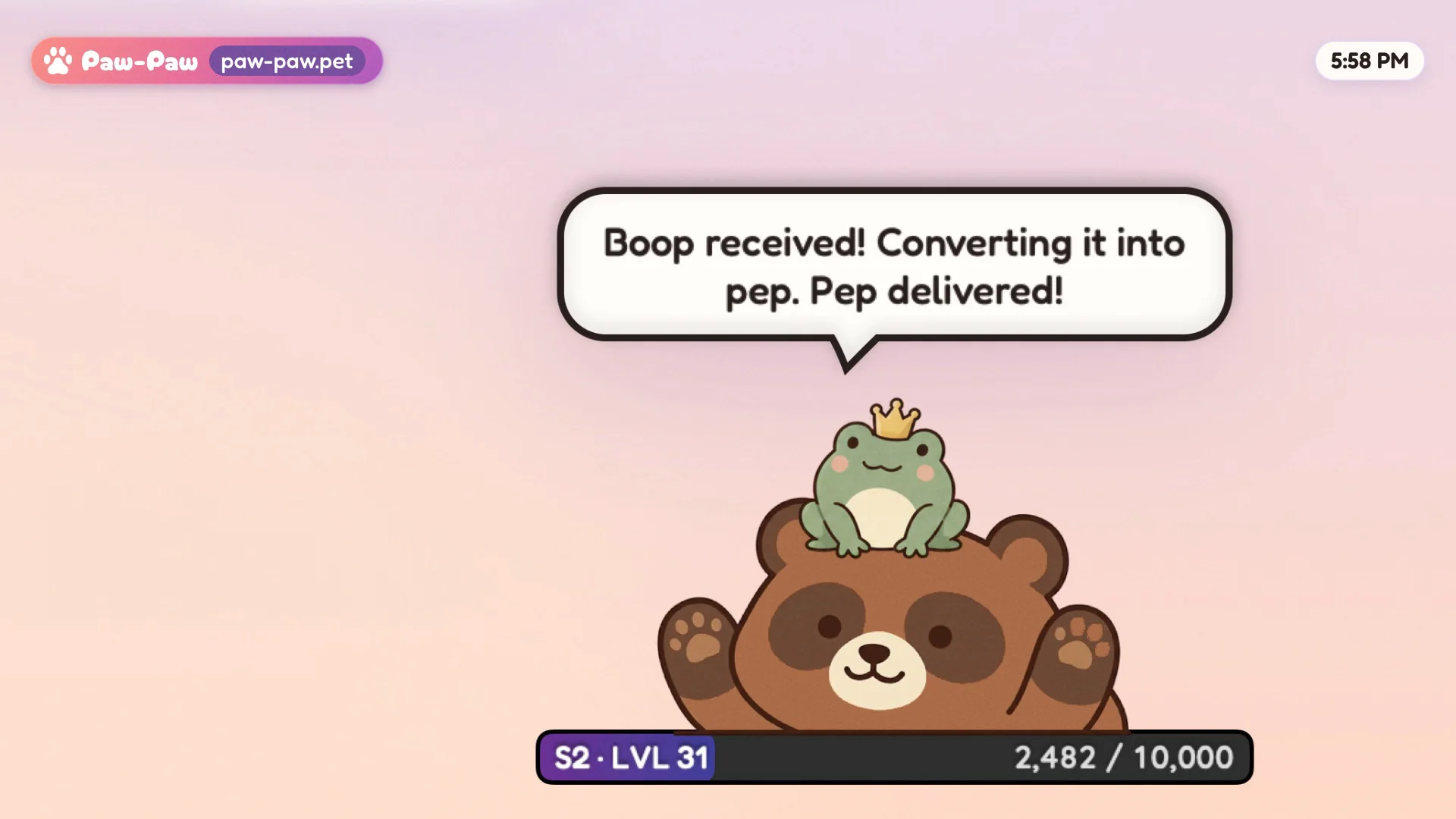
Your Paw-Paw stays in one spot above your windows, and its paws tap as you type and click. There is no session to book, no camera and nobody watching: just a small, steady sense of company.
It notices when your pace dips, gently
Paw-Paw compares your last ten minutes with your own usual pace over the couple of hours before, leaving out long breaks such as lunch. Only when you have slowed well below your own rhythm does it offer a kind word, and never more often than every 20 to 30 minutes. It never compares you with anyone else, and the pace lives in memory only.
Its lines follow the research
The bubbles praise effort rather than talent, invite rather than order, shrink the first step, and treat rest as part of the work. They talk about work in general, never about what you are doing, and you can switch the automatic bubbles off in Settings. Click your Paw-Paw any time it is awake and it says something new.
Progress you can see
Every key press and click fills the XP bar under your Paw-Paw, and each new level brings a gift to open. That is the goal-gradient idea on your desktop: a visible bar that fills a little as you go. On a slow day, a cheer from your Paw-Paw can even bring a free gift, at most once a day.
It rests when you do
After two minutes without input your Paw-Paw curls up for a nap. Nothing bad happens while you are away: no hunger, no guilt, no streak to lose. Your next key press wakes it.
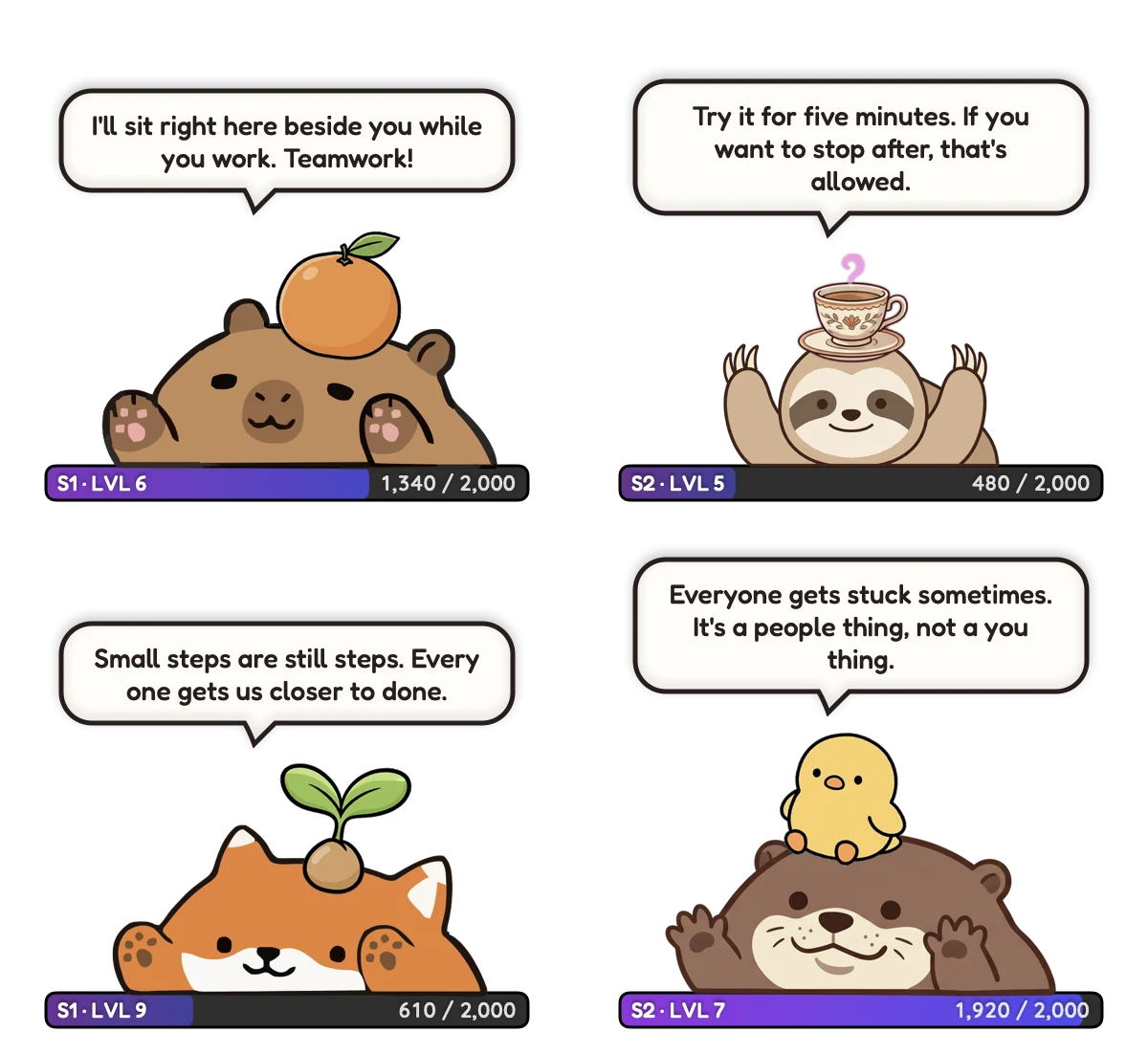
Here is how a few real lines from the app map to the research:
| Principle | A line your Paw-Paw might say |
|---|---|
| Not alone | I'll sit right here beside you while you work. Teamwork! |
| Small wins | Small steps are still steps. Every one gets us closer to done. |
| Shrink the first step | Try it for five minutes. If you want to stop after, that's allowed. |
| Kindness when stuck | Everyone gets stuck sometimes. It's a people thing, not a you thing. |
| Offer choice | You get to pick what's next. I'll cheer for whatever you choose. |
| Rest is part of the work | Oh! I dozed off. Resting is productive too, you know. Okay, ready! |
Each Paw-Paw also has lines in its own voice. The fox, for example, likes to say that clever foxes split a big hunt into small hops. You can read how levels, gifts and On Fire work in our guide to how Paw-Paw works.
A simple way to try it
- Pick one routine task. Inbox, a tidy-up pass, a familiar chunk of code: the kind of work where company helps most.
- Put your Paw-Paw at the edge of your screen. It starts by the Dock; drag it anywhere, and choose Small, Medium or Large in Settings.
- Work, and let it keep you company. When you are stuck, click it for a line. Don’t turn collecting items into the task.
- Check the effect, not the promise. If starting felt easier or the afternoon less lonely, keep it. If it pulls your eyes away, turn on Click-Through, make it fainter, or close it.
- Add a person when you need accountability. For deadlines and hard projects, pair Paw-Paw with a friend, a library or a coworking session.
Paw-Paw needs macOS 13 or later and runs on Apple silicon and Intel Macs. Our setup guide walks through the download and the Accessibility step.
Frequently asked questions
What is a digital body double?
A digital body double is company you work alongside through a screen instead of in the same room: a video coworking session, a live or recorded study-with-me stream, or a lighter on-screen presence such as an animated companion. The idea comes from body doubling, using another person's presence to start, stay on or finish a task.
Does body doubling actually work?
People report finding body doubling useful, but the sources discussed here are limited: surveys, qualitative work and small comparative studies. They do not establish a desktop pet as an ADHD treatment. Adjacent social-facilitation research finds small, task-dependent effects of other people’s presence; it does not directly test Paw-Paw.
Can an app be a body double?
An app can supply some of what body doubling offers, such as a visible presence, a cue to keep going and a little warmth, but not a person who expects you to show up. Paw-Paw is an ambient companion of that kind, not a human body-doubling service. For accountability, pair it with a friend, a library or a virtual coworking session.
Does encouragement improve productivity?
Small, frequent encouragement and visible progress are linked to more effort and motivation in several studies: a single thank-you raised voluntary help in experiments by Grant and Gino, frequent verbal encouragement raised effort in exercise tests, and making progress on meaningful work was associated with better mood and motivation in Amabile and Kramer's diary study. These are specific settings, so expect a nudge, not a guaranteed productivity gain.
Does Paw-Paw see what I type?
No. Paw-Paw needs macOS Accessibility access to notice key presses and clicks. It counts them, never what you type, and the pace it uses for encouragement is kept in memory only. Its speech bubbles talk about work in general, never about your actual input.
Is Paw-Paw free?
Yes. Paw-Paw is free, with no ads, subscription or account needed, and runs on Macs with macOS 13 or later, Apple silicon and Intel. The one optional extra is an artist collection, a one-time USD 2.99 purchase inside the app.
Research and further reading
- Anderson, L. (1996). The Body Double. Republished by ADDA.
- Eagle, T., Baltaxe-Admony, L. B., & Ringland, K. E. (2024). An investigation of body doubling with neurodivergent participants. ACM Transactions on Accessible Computing.
- Lee, Y., et al. (2021). How people use “study with me” videos. CHI ’21.
- Tan, V., Hegemann, K., & Gerken, J. (2026). A roadmap of mixed reality body doubling for adults with ADHD. arXiv.
- Ara, Z., et al. (2025). You are not alone: designing body doubling for ADHD in virtual reality. arXiv preprint.
- Bond, C. F., & Titus, L. J. (1983). Social facilitation: a meta-analysis of 241 studies. Psychological Bulletin.
- Zajonc, R. B. (1965). Social facilitation. Science. Triplett, N. (1898). The dynamogenic factors in pacemaking and competition.
- Gallup (2024). 1 in 5 employees worldwide feel lonely.
- Grant, A. M., & Gino, F. (2010). A little thanks goes a long way. Journal of Personality and Social Psychology.
- Andreacci, J. L., et al. (2002). Frequency of encouragement and performance during maximal exercise testing; Ketelhut, S., et al. (2025). Encouragement strategies in maximal exercise tests: a scoping review.
- Amabile, T. M., & Kramer, S. J. (2011). The power of small wins. Harvard Business Review.
- Kivetz, R., Urminsky, O., & Zheng, Y. (2006). The goal-gradient hypothesis resurrected. Journal of Marketing Research.
- Sirois, F., & Pychyl, T. (2013). Procrastination and the priority of short-term mood regulation; Breines, J. G., & Chen, S. (2012). Self-compassion increases self-improvement motivation.
- Sailer, M., & Homner, L. (2020). The gamification of learning: a meta-analysis. Educational Psychology Review.
- Lin, J. J., et al. (2006). Fish’n’Steps: encouraging physical activity with an interactive computer game; Lester, J. C., et al. (1997). The persona effect.
- Nittono, H., et al. (2012). The power of kawaii: viewing cute images promotes a careful behavior and narrows attentional focus. PLOS ONE.
- Albulescu, P., et al. (2022). “Give me a break!” A meta-analysis on micro-breaks. PLOS ONE.

Work with a little company
Free, with no ads, subscription, account or camera. A tiny animal that types along, rests when you rest, and cheers you on.
Download Free for MacFree · macOS 13+ · Apple silicon + Intel