Cuteness, care and the research
Can cute things help you focus?
A famous study from Japan says looking at kittens makes you more careful. Here is what it and the study before it really measured, the larger replications that found nothing, and what that leaves for a cute companion on your desk.
Possibly a little, for a few minutes, and mostly for careful work. In small lab studies, students who looked at photos of puppies and kittens for a minute or two did short, fiddly tasks more accurately than students who saw adult dogs and cats. Two larger, pre-registered replications found no difference. Nobody has tested a cute companion on a screen over a working afternoon, including us.
Why researchers expected cute to matter
The idea starts with the baby schema: features common to young animals and human babies, such as a large head for the body, a high forehead and large eyes. The ethologist Konrad Lorenz assumed in 1943 that our responses to them are innate. Later studies, as Nittono and colleagues sum them up, report that these features are rated cute, catch the eye and make people want to approach and care; one brain-imaging study links them to the brain’s reward system.
These are theories with supporting studies, not settled facts. The experiments below ask a narrower question: does seeing something cute change what you do in the next few minutes?
The Operation game study (2009)
Gary Sherman, Jonathan Haidt and James Coan at the University of Virginia used the children’s game Operation: lift little plastic body parts out with tweezers without touching the edges. People played it, watched a slide show, and played again. The middle of the slide show held nine animal photos, ten seconds each: puppies and kittens for one group, adult dogs and cats for the other (Sherman, Haidt & Coan, 2009).
- Experiment 1: 40 undergraduate women. The puppy-and-kitten group improved more on Operation (d = 0.63). They also reported more tenderness, happiness and amusement, and the more tender they felt, the more they improved (r = 0.34).
- Experiment 2: 56 students, women and men, with new photos matched on how interesting, enjoyable and exciting they were. The effect held (d = 0.48); the test for a gender difference was not significant.
The fine print: two small experiments, both only just past the usual p < .05 line, and one outcome, with speed not measured. And one detail matters for anything cartoon-shaped: the authors chose photographs on purpose, because simple schematic drawings tend to be “relatively weak as emotion elicitors.”
The power of kawaii: three experiments (2012)
Three years later, Hiroshi Nittono, Michiko Fukushima, Akihiro Yano and Hiroki Moriya at Hiroshima University asked whether the effect was really about caring, or about attention in general. Their paper in PLOS ONE gave the topic its name: The Power of Kawaii. All participants were Japanese university students.
| Experiment | What people did | What happened |
|---|---|---|
| 1. Tweezers game | 48 students played a tweezers game much like Operation, then spent 90 seconds ranking seven printed animal photos, then played again. | Successful moves rose 44% after puppies and kittens, against 12% after adult dogs and cats. The cute group also took 12% longer, against about 1%: they worked more slowly and carefully. |
| 2. Digit search | 48 new students, 16 per group, counted a target digit in rows of random digits for three minutes. A third group saw pleasant food instead: steak, pasta, sushi. | Correct answers rose 16% after baby animals, 1% after adult animals and 1% after food. With a fixed time limit, this group was faster too. Gains went with how cute and baby-like people rated the photos, not with how pleasant. |
| 3. Big and small letters | 36 students saw letters made of smaller letters and pressed a key for H or T, after looking at each photo for 3 seconds. Everyone saw baby animals, adult animals and neutral objects in turn. | People are usually quicker with the big letter than the small ones. That head start was no longer significant after baby animals, but the key test comparing the three conditions was only a trend (p = .07). |
Experiment 2 matters most: the task had nothing to do with caring, and pleasant food did nothing, so the effect was not just about feeling good. The authors read the set as cute images making people more careful and possibly narrowing their attention. Before repeating the headline, know the limits:
- Small groups, 16 to 24 people per condition, compared with other animals rather than with no pictures at all.
- Experiment 3 is weaker than the abstract sounds. The abstract says the big-letter head start was reduced; the key test was only a trend.
- The mechanism is open. The authors discuss two explanations and say their data cannot decide between them.
- Driving and office work were a suggestion, not a test. Nobody in the study drove or worked an office shift.
Coverage still ran headlines such as “Looking at Cute Images Can Improve Focus”. What was measured was accuracy on tasks lasting minutes, straight after a short look at photos.
The replications that found nothing (2022)
Gal Ziv and Orly Fox at the Academic College at Wingate in Israel set out to replicate the effect with a stricter design. They registered their plan in advance, worked out beforehand that they needed 98 people to detect a moderate effect, and ran the study online, so the researchers never met the participants.
The 98 adults, recruited through Prolific, used their own computers. As in Nittono’s study, they ranked seven animal photos: 48 saw puppies and kittens, 50 saw adult dogs and cats. Before and after, they did two attention tasks against the clock: a Simon task, where you answer by the meaning of a cue and ignore where it appears, and a task-switching test, where the rule changes back and forth.
- The pictures worked as intended. People rated the puppies and kittens cuter and much more baby-like.
- Performance did not differ. Everyone did better the second time, but the groups did not differ in correct answers or reaction times, even when the authors compared only the people who rated their photos cutest and least cute.
- One loose thread, tested. In an exploratory analysis, pet owners got faster at task switching after cute images. So the same team ran a second pre-registered study with 164 people, dog owners and non-owners, shown puppies or adult dogs. Again, puppies made no difference to either task (Fox & Ziv, 2022).
The authors suggest the effect may mainly concern fine motor tasks like the tweezers game, which their computer tasks did not need. They also note two later positive studies from Japan: one on fine motor skill (2020) and one on basketball free throws (2021).
Where that leaves the evidence: a handful of positive experiments and two larger pre-registered nulls, all built on the same design of pet photos followed by a brief task. That is mixed, not settled. And the first null came from the setup closest to desk life: ordinary adults at home, on their own computers.
What about cat videos?
The other study that often turns up in “cute and productivity” searches is about internet cats. In 2015 Jessica Gall Myrick, then at Indiana University, surveyed almost 7,000 people about watching cat videos, published in Computers in Human Behavior. The survey was shared on social media with help from the owner of Lil Bub, a famous internet cat.
Respondents said they felt more energetic and positive, and less anxious, annoyed or sad, after watching than before. Many watched at work or while studying, the pleasure outweighed any guilt about procrastinating, and they went looking for only about a quarter of the videos.
This is a survey, not an experiment: self-selected cat fans recalling how they felt, with no comparison group and no measure of work. Myrick suggested the emotional pay-off may help people take on tough tasks afterwards, but that was not tested. It supports “cat videos lift many viewers’ mood”, not “cat videos make you more productive”.
What this means for your desk
Put together, the honest reading is small:
- Expect care, not speed. The positive results were about accuracy on fiddly tasks, and in the tweezers game people slowed down. Careful work such as proofreading or checking numbers is the closest match to what was measured.
- Keep the glance a glance. People looked at photos for a minute or two, then did a task lasting minutes: a few puppies, not an hour of scrolling. How long any effect lasts, or whether something cute in view all day works the same way, was never measured.
- Photos were tested; cartoons were not. Illustrated characters, emoji and on-screen pets are untested.
- The surest part is the feeling. People said cute pictures made them feel tender, happy or more positive. That is a fine reason to keep something cute nearby, as long as you don’t expect it to do your planning.
For a proper pause, a short break away from the screen has its own research, covered in our guide to micro-breaks. If what you miss is company rather than cuteness, see our digital body double guide and the page on working from home alone.
Where Paw-Paw fits, honestly
We make Paw-Paw, a free desktop pet for Mac, so read this part as the makers describing their own app. We would love to tell you it sharpens your focus. We can’t: it is drawn, not photographed, and it stays on screen and moves while you work, which is not what any of these studies tested.
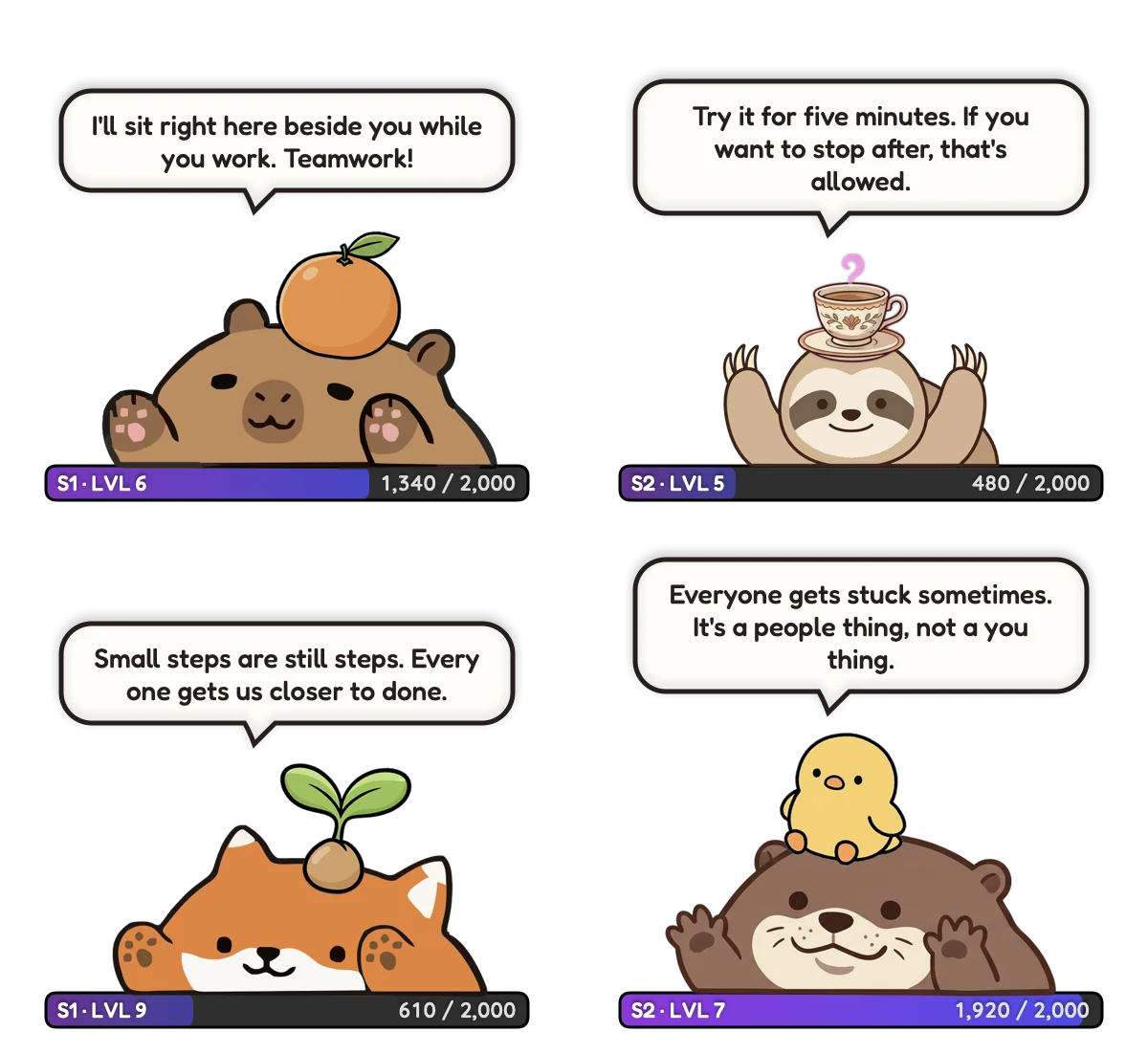
What we can tell you is what it does:
It sits beside your work
Your Paw-Paw sits above your windows, by the Dock at first; drag it anywhere and size it from 30% to 150%. Its paws tap as you type and click, and after two minutes without input it naps. No hunger, no guilt, no streak to lose.
It mostly stays quiet
Only when your pace dips well below your own usual pace may it offer a kind word, never more than every 20 to 30 minutes at Normal. Talkativeness in Settings goes from Quiet to Chatty, and you can click it any time for a line.
A focus timer and breaks, if you want them
Right-click your Paw-Paw and choose When Clicked › Start Focus Timer. A click then opens a timer from 1 minute to 3 hours; at the end your Paw-Paw cheers and offers a break sized to the session. Separate reminders can nudge you to get up, stretch, drink water or rest your eyes.
Paw-Paw asks for macOS Accessibility access when you turn on XP, so it can notice key presses and clicks; it counts them, never what you type. If it pulls your eyes away, make it smaller or close it. If it simply makes the afternoon friendlier, that is reason enough. Our guide to how Paw-Paw works and setup guide cover the rest.
Frequently asked questions
Does looking at cute things help you focus?
Possibly a little, for a few minutes, and mostly for careful work. In small lab studies, university students who looked at photos of puppies and kittens for a minute or two then did short, fiddly tasks more accurately than students who saw adult dogs and cats. Two larger pre-registered studies found no difference, so the evidence is mixed.
What is the power of kawaii study?
It is a 2012 PLOS ONE paper by Hiroshi Nittono and colleagues at Hiroshima University. In two experiments with 48 students each, photos of baby animals were followed by better accuracy on a tweezers game and a digit-search task than photos of adult animals. A third experiment, on how broadly people pay attention, showed only a statistical trend.
Has the cute images effect been replicated?
Partly. Sherman, Haidt and Coan found it twice in 2009, Nittono's team found it in 2012, and later studies from Japan reported similar results. Two pre-registered studies by Ziv and Fox, with 98 and 164 adults, found no difference between people who saw baby animals and people who saw adult ones. The studies are small and the evidence is mixed.
Do cat videos make you more productive?
No study we found shows that. In a 2015 survey of almost 7,000 people by Jessica Gall Myrick, viewers said they felt more energetic and positive after watching cat videos than before. It was a self-selected online survey that asked people how they felt; it did not measure their work.
Does a cute desktop pet improve focus?
Nobody has tested that, including us. The studies showed photos of real baby animals for a minute or two before a short task, not a drawn character that stays on screen all afternoon. Paw-Paw is a free Mac desktop pet that keeps you company, and we don't claim it improves focus.
Sources
- Sherman, G. D., Haidt, J., & Coan, J. A. (2009). Viewing cute images increases behavioral carefulness. Emotion, 9(2), 282–286.
- Nittono, H., Fukushima, M., Yano, A., & Moriya, H. (2012). The power of kawaii: viewing cute images promotes a careful behavior and narrows attentional focus. PLOS ONE, 7(9), e46362.
- Ziv, G., & Fox, O. (2022). Viewing cute images does not affect performance of computerized reaction time tasks. Frontiers in Psychology, 12, 800543.
- Fox, O., & Ziv, G. (2022). The effects of viewing cute images on the performance of simple computerized tasks in dog owners and non-dog owners. PeerJ, 10, e14439.
- Yoshikawa, Nittono & Masaki (2020). Effects of viewing cute pictures on quiet eye duration and fine motor task performance. Frontiers in Psychology, 11, 1565. Summarised here as described by Ziv & Fox.
- Myrick, J. G. (2015). Emotion regulation, procrastination, and watching cat videos online: who watches Internet cats, why, and to what effect? Computers in Human Behavior. Findings as reported by Indiana University.
- Background cited by Nittono et al. (2012): Lorenz, K. (1943). Die angeborenen Formen möglicher Erfahrung. Zeitschrift für Tierpsychologie; Glocker, M. L., et al. (2009). Baby schema in infant faces induces cuteness perception and motivation for caretaking in adults. Ethology; Glocker, M. L., et al. (2009). Baby schema modulates the brain reward system in nulliparous women. PNAS.
- Association for Psychological Science. The power of puppies: looking at cute images can improve focus.

A little cute on your desk
Free, with no ads, subscription or account. A tiny animal that types along with you and naps when you rest.
Download Free for MacFree · macOS 13+ · Apple silicon + Intel