Remote work and company
Working from home alone: small ways to feel less lonely at your desk
If the house gets very quiet by mid-afternoon, you are not the only one. Here is what the surveys show, what tends to help, and what pets, AI companions and a tiny desk companion can and can’t do.
Feeling lonely when you work from home is common. In Gallup’s 2024 workplace research, 25% of fully remote employees said they had felt lonely a lot of the previous day, against 16% of people working on-site. In Buffer’s 2023 survey, 23% of remote workers named loneliness as a struggle. What helps most involves people: a regular reason to leave the house, working near others, calls you put in the calendar, and a life outside work. A small desktop companion such as Paw-Paw can add light company and a kind word to the day. It doesn’t replace people, and it isn’t therapy.
What the numbers say
Gallup published some of the clearest recent figures in June 2024. Drawing on its global workplace report, it wrote that one in five employees worldwide had felt lonely a lot of the previous day. When it split the answers by where people work, fully remote employees reported the most loneliness:
| Where people work | Felt lonely a lot of the previous day |
|---|---|
| Fully remote | 25% |
| Hybrid | 21% |
| Fully on-site | 16% |
One caveat: Gallup doesn’t say exactly which survey the split comes from. Its 2024 State of the Global Workplace summary gives it right after the global figure, but the only methods note under the article describes a US sample of 19,846 workers in the Gallup Panel, surveyed in February 2024. The pattern held up a year later, though. Gallup’s 2025 global report again found fully remote employees more likely than hybrid and on-site workers to report loneliness. Gallup also found that work itself goes with less loneliness: 20% of working adults reported it, against 32% of unemployed adults.
Buffer’s State of Remote Work 2023 asked 3,000 remote workers around the world, including freelancers and business owners, which struggles they had. The top answer, from 33%, was staying home too often because they had no reason to leave. Next came loneliness, at 23%. Asked for their single biggest struggle, 21% chose staying home too often and 15% chose loneliness. These were picks from a list, not a loneliness score, and the same group mostly liked remote work: 91% described their experience as positive.
For wider context, the US Surgeon General published an advisory in 2023, Our Epidemic of Loneliness and Isolation, on the health effects of social connection. It is about everyone, not remote workers in particular, and its summary says poor social relationships, isolation and loneliness can raise the risk of heart disease by 29% and of stroke by 32%.
None of these surveys proves that remote work causes loneliness. They do show that if you feel it, plenty of people are feeling it too.
People first: what tends to help
Most advice on remote-work loneliness comes from experience, forums and company blogs rather than trials, so treat this list as things worth trying, not proven fixes. What they share is that each one brings people back into your week.
- Give yourself a reason to leave. Buffer’s top struggle was staying home with no reason to go out. Put something outside on the calendar: a class, a walk with a friend, a regular café morning. Owl Labs, which sells video-meeting hardware, suggests working at least one day a week outside the home, at a coworking space, café or library.
- Work near other people. A coworking desk or a library table gives you faces without meetings. If you are employed, it is worth asking about a membership: in Buffer’s survey, 22% said their company paid for coworking, and another 38% wished theirs would.
- Try virtual coworking. Services such as Focusmate pair you with another person on video for a block of quiet work. That is body doubling, and our digital body double guide covers what the research says about it.
- Book calls like meetings. A short call with a colleague or a friend that sits in the calendar tends to happen; the one you mean to make often doesn’t.
- Give the day a shape. A start time, a lunch away from the desk and a clear finish keep the day from turning into one long afternoon alone.
- Build a life outside work. The writer Sheryl Garratt suggests making plans for after work and linking up with other people who do the same job as you.
- Get outside, even briefly. A walk around the block in daylight, a coffee bought in person, a hello to a neighbor: small doses of the world count.
If you have a team, it is fair to tell them you feel cut off. Gallup’s advice to employers points the same way: work that feels meaningful and connected goes with less loneliness.
Do pets help?
A dog asleep under the desk or a cat walking across the keyboard is real company. The research is thinner than the enthusiasm, though:
- Lower stress in some studies. NIH News in Health summarized studies in which interacting with animals lowered cortisol, a stress hormone, and blood pressure.
- Careful wording from reviewers. A 2024 scoping review of pets in the workplace looked at 31 studies, including some on pets at home during remote work. It found that employees’ pets “may reduce stress” and improve attitudes to work, but that this may not apply to every employee or workplace. Most of the studies were surveys without validated stress measures.
The research measures stress and wellbeing more than loneliness, and we found no trial showing that pets reduce loneliness in remote workers. A pet is also a long commitment, so it is a good reason to adopt only if you want the animal itself.
Virtual and AI companions
Chatbots built to be friends are new, and so is the research on them. The early results point both ways:
- Some relief. The American Psychological Association’s Monitor (January 2026) summarized a Harvard Business School study in which talking with an AI companion eased loneliness about as much as talking with another person. It also described an OpenAI and MIT Media Lab study where voice chat helped with moderate use, while heavy daily use went with more loneliness.
- Some harm. A Stanford study published in Nature Human Behaviour in 2026 surveyed 1,131 US adults who use Character.AI. People with smaller offline social circles were more likely to use the chatbot mainly for companionship, and that use went with lower wellbeing, more so when it was intense. The senior researcher, Diyi Yang, concluded that chatbots used this way don’t substitute for human connection.
These are mostly surveys and short experiments, and they show associations rather than causes. What we take from them: a companion app may help as a small extra, and it can hurt when it quietly takes the place of people.
Where a small desktop companion fits
We make Paw-Paw, so read this part as the makers describing their own app. Paw-Paw is a free desktop pet for Mac, not a chatbot. It doesn’t hold conversations or ask how you feel, and we haven’t studied whether it changes loneliness. What it offers is lighter:
Someone small on the screen
Your Paw-Paw sits above your windows, by the Dock at first, and you can drag it anywhere. Its paws tap as you type and click, so a little someone is working along with you.
A kind word now and then
When your pace dips well below your own usual pace, it may offer an encouraging line, at most every 20 to 30 minutes at the Normal setting. It compares you only with yourself. Click it any time for a line, or set Talkativeness to Quiet, Normal, Chatty or Custom in Settings.
A nudge to get up
After a long stretch of work, your Paw-Paw suggests a stretch, a walk or some water. It suggests; you decide. In Settings › Notifications › Breaks there are four break reminders, each on its own timer: get up and move, stretch, drink water and rest your eyes. Turn any of them off.
No guilt when you leave
After two minutes without input it naps, and your next key press wakes it. Nothing bad happens while you are away: no hunger, no guilt, no streak to lose. Going out to see people never costs you anything.
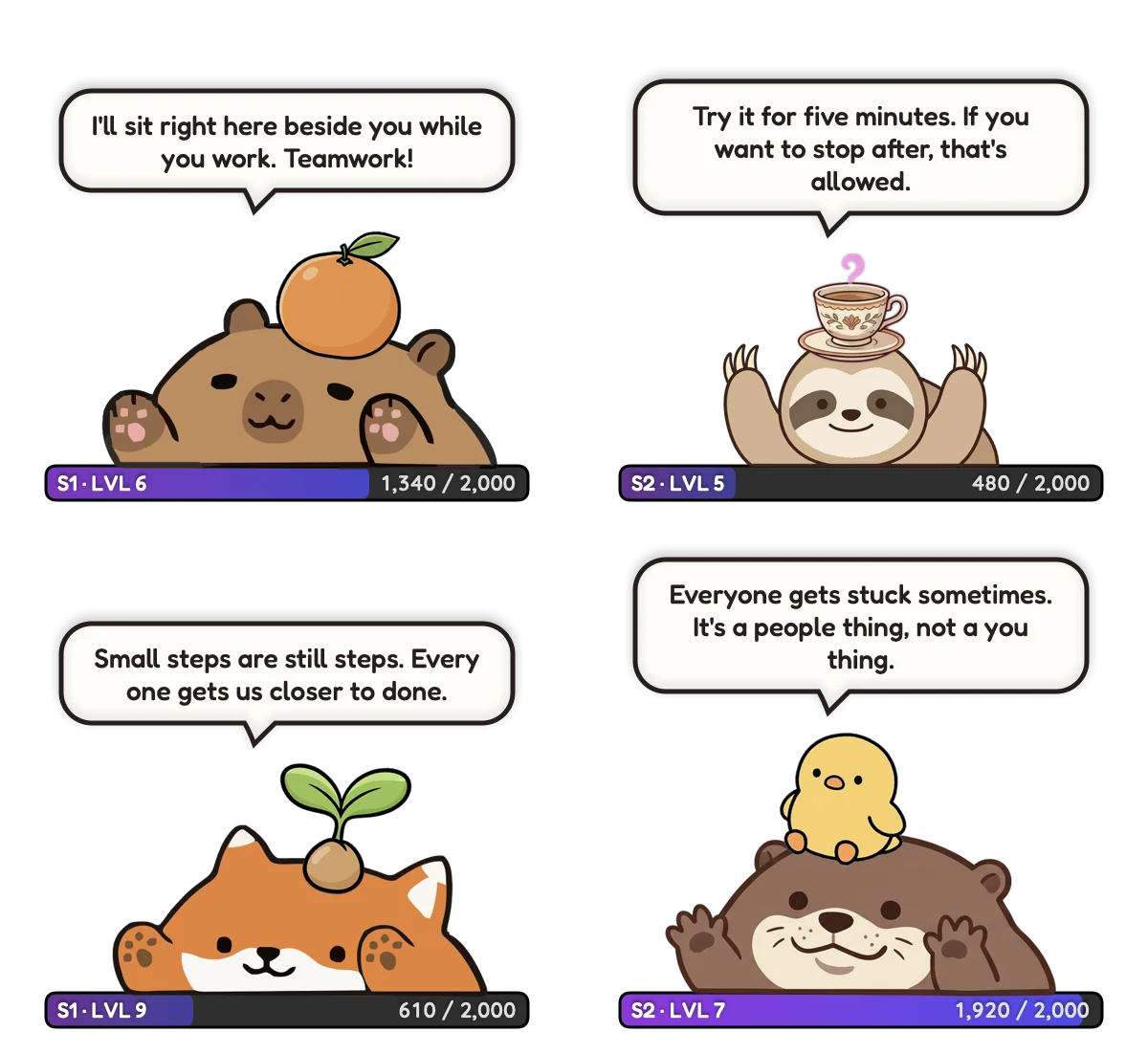
To notice key presses and clicks, Paw-Paw asks for macOS Accessibility access when you turn on XP. It counts them, never what you type. Our guide to how Paw-Paw works covers levels, gifts and items, and the setup guide walks through the download.
Think of it as a small extra for the hours you spend alone at your desk, next to the people in your life rather than instead of them.
If loneliness is weighing on you
Loneliness is a common human feeling, not a personal failing. If it has gone on for weeks, or it is affecting your sleep, mood or work, please tell someone you trust and talk to a doctor or a counselor; they can help you find support that fits. If you ever feel unsafe or think about harming yourself, contact your local emergency number or a crisis line in your country right away. A desktop pet can’t do that job, and it shouldn’t try.
Frequently asked questions
Is it normal to feel lonely working from home?
Yes, it is common. In Gallup's 2024 workplace research, 25% of fully remote employees said they had felt lonely a lot of the previous day, compared with 21% of hybrid and 16% of on-site workers. In Buffer's 2023 survey of remote workers, 23% named loneliness as one of their struggles.
How can I feel less alone working from home?
Bring people back into your week: give yourself a regular reason to leave the house, work from a coworking space, library or café some days, try virtual coworking, book calls with colleagues or friends like meetings, and keep plans outside work. A small desktop companion can add light company at your desk, but it works best as an extra, not a replacement for people.
Do pets help with loneliness when working from home?
Maybe, for some people. Some studies link time with animals to lower stress, and a 2024 scoping review found that pets at work may reduce stress. The studies are mostly surveys, they measure stress more than loneliness, and we found none showing that pets reduce loneliness in remote workers.
Can an AI companion help with loneliness?
The research is early and mixed. Some studies find that talking with an AI companion can ease loneliness, at least with moderate use, while a 2026 Stanford study of Character.AI users found that using a chatbot mainly for companionship went with lower wellbeing, and that people with smaller offline social circles were more likely to use it that way. Treat any companion app as an extra, not a substitute for people.
Is Paw-Paw a replacement for people or therapy?
No. Paw-Paw is a free desktop pet for Mac that types along with you, naps when you rest and now and then offers a kind word. It is not a chatbot, a therapy app or a medical tool. If loneliness is weighing on you, talk to someone you trust, or to a doctor or counselor.
Is Paw-Paw free?
Yes. Paw-Paw is free, with no ads, subscription or account needed, and runs on Macs with macOS 13 or later, Apple silicon and Intel. The optional extras are artist collections you buy once inside the app.
Sources
- Pendell, R. (2024, June 11). 1 in 5 employees worldwide feel lonely. Gallup. Methods note: Gallup Panel, US workers, February 2024 (n = 19,846).
- Pendell, R. (2025, May 7). The remote work paradox: higher engagement, lower wellbeing. Gallup.
- Buffer (2023). State of Remote Work 2023. Survey of 3,000 remote workers.
- Office of the US Surgeon General (2023). Our Epidemic of Loneliness and Isolation (full advisory, PDF). US Department of Health and Human Services.
- Owl Labs. 10 tips to avoid remote work loneliness. Company blog.
- Garratt, S. Feeling lonely, working from home? Here’s what to do. LinkedIn.
- Focusmate. Body doubling: what it is, why it works. Company page.
- NIH News in Health (2018, February). The power of pets. National Institutes of Health.
- Gardner, D. H. (2024). Pets in the workplace: a scoping review. New Zealand Veterinary Journal, 72(6), 307–316.
- Andoh, E. (2026, January). AI chatbots and digital companions are reshaping emotional connection. Monitor on Psychology, 57(1).
- Gelfand, A. (2026, August 4). AI companions may worsen loneliness for vulnerable users. Stanford Report. Study: Nature Human Behaviour.

A little company for the quiet hours
Free, with no ads, subscription or account. A tiny animal that types along, naps when you rest, and has a kind word now and then.
Download Free for MacFree · macOS 13+ · Apple silicon + Intel